Background
Queensbury Tunnel, at 2,501 yards (2,287 metres) in length, was one of the most significant engineering feats ever undertaken by the Great Northern Railway. For most of its operational life, it was the 22nd longest railway tunnel on the UK’s rail network (11th longest at the time of opening), forming part of a strategically important north-south route that avoided the congested lines around Leeds and Bradford.
Construction work began in May 1874 under the auspices of contractor Benton & Woodiwiss whose agreement obligated them to complete it in two years. Initially, activity was concentrated at the two ends - where extensive approach cuttings were excavated - and seven construction shafts located across the hill. However, when additional working faces were opened below ground, even more opportunity arose for mishap.
Such was the severity of the challenges facing the engineers and navvies, it was not until July 1878 that the tunnel was eventually finished. Driving this substantial delay was a conspiracy of circumstance, most notably the huge amount of water penetrating the workings. This resulted in the abandonment of Nos. 5 & 6 shafts in 1875, whilst No.3 shaft was not worked southwards for a lengthy period.
Shortly before work finished, a reporter from the Halifax Guardian walked through the tunnel, describing the scene inside. He was inspired to remark that “The pyramids of Egypt sink into insignficance compared with such a work”. Whilst this statement is extravagant, it does reflect the extent to which great engineering endeavours were held in awe by the Victorians.
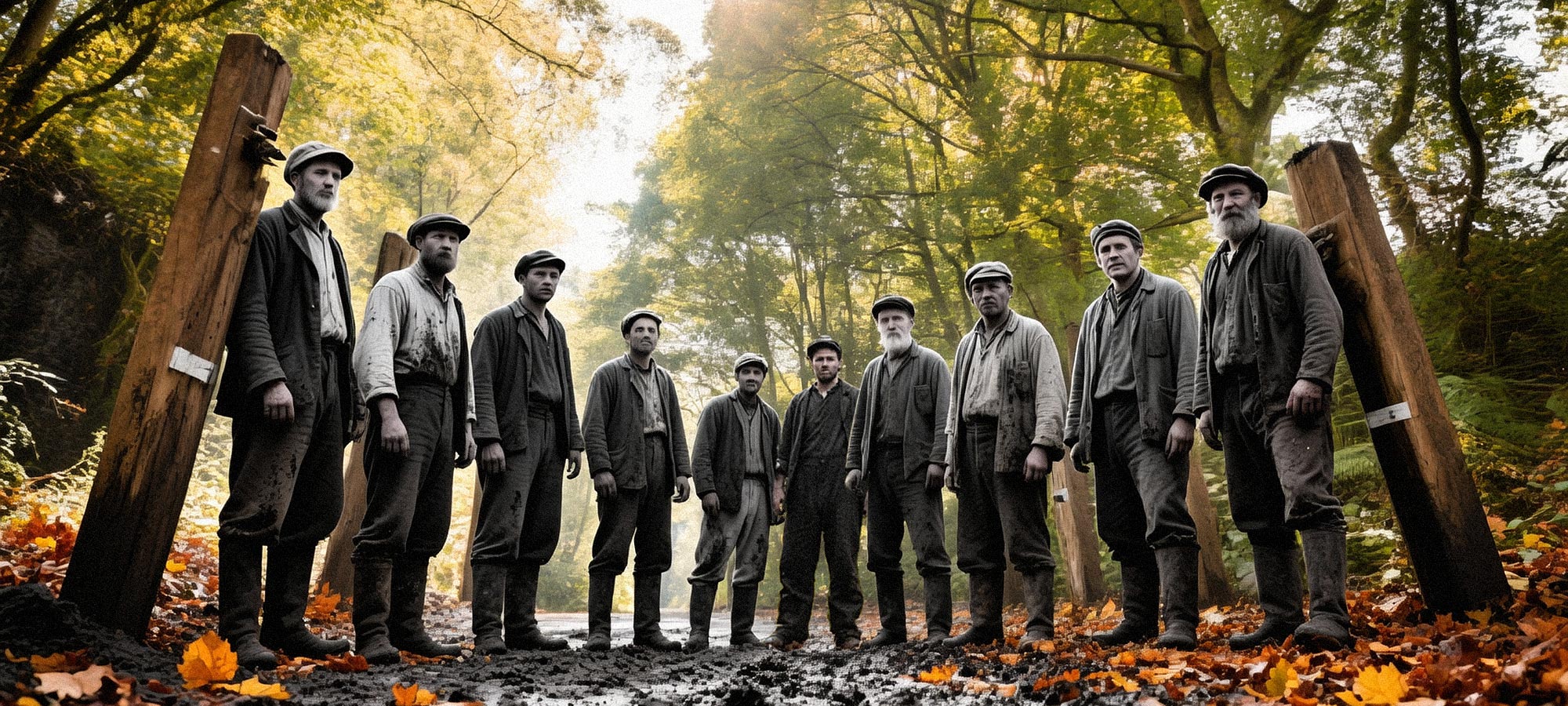
The workforce
Today, we can easily be distracted by the mechanical and technological advantages available to project teams, but this cannot diminish the remarkable nature of Queensbury Tunnel given the construction methodology used in the 1870s. Although stationary engines and locomotives helped with the heavy lifting and transportation of materials, the tunnel was substantially a product of manual labour. Around 600 men - 200 of whom were miners - were involved in building it, whilst another hundred or so progressed the sections of line immediately adjacent. They were supported by 14 horses.
Working conditions were unimaginable, with poor air, incessant water ingress and the purest conceivable darkness; light was provided only by candles. The nature of the activities exposed those involved to great danger; very few health and safety measures were available to mitigate the risks. As a result, accidents occurred in significant numbers. Whilst many of these proved minor, some were life-changing: burns, loss of limbs, crush injuries etc. In the certain case of ten men, the outcome of their misadventure proved fatal and, although no direct evidence has been found, it remains possible that others also lost their lives, such was the extent of their injuries.
The casualties were Richard Sutcliffe (30), John Swire (44), Henry Ingham (36), Sutcliffe Hodgson (29), Henry Jones (39), John Gough (40), Richard Jones (33), Llewellyn Jones (31), Frederick Goulding (25) and Captain Pickles (30). Ten deaths indicate a fatality rate for Queensbury Tunnel of at least one worker in every 60. Convention dictates that many more would also have suffered major injuries during the construction period. And around one in ten horses were literally worked to death as work progressed on a typical tunnel.
The 'Ten Men' Memorial
The Queensbury Tunnel Society has erected the adjacent memorial to the ten men who paid the ultimate price. The materials were mostly provided by the Keighley & Worth Valley Railway, prepared by Richard Kunz and installed by Mick Dowse and David Sunderland - all supporters of the Society's campaign to reopen the tunnel as part of a Bradford-Halifax Greenway.
On the back of each sleeper is another QR code which links to a page about the navvy named on the front; this describes the circumstances of their death and, where known, biographical information.